
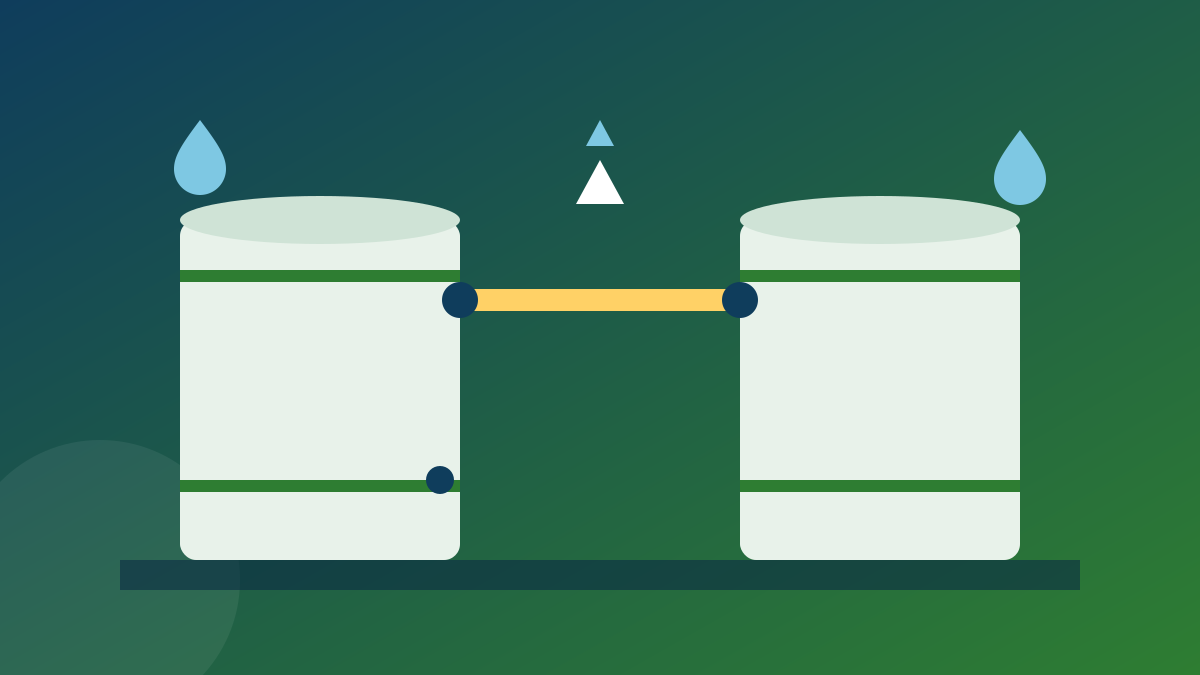
Linking two rain barrels together doubles your storage from 55 to 110 gallons, and it is the cheapest way to get more water without buying a bigger tank. Place the barrels side by side on level ground, connect them near the top with a short hose or pipe, and put the overflow on the last barrel in the chain. The two barrels then fill and drain as one unit, and you water from the spigot on the first barrel.
Barrel water is for non-potable use only: ornamental beds, lawns, and outdoor cleaning. It is not drinking water, and linking barrels does not change that.
Why Link Barrels Instead of Buying a Bigger Tank?
Two linked 55-gallon barrels cost less than most 110-gallon tanks, and they are easier to move, easier to fit through a gate, and easier to replace one at a time. A single barrel weighs about 460 pounds when full, which is already heavy; a 110-gallon tank weighs twice that and needs a much stronger stand and a bigger footprint. Two barrels also give you flexibility: if one cracks, you still have the other, and you can add a third barrel later without starting over.
The main reason to link is watering time. One barrel gives you about one deep watering of a 100 square foot ornamental bed, which needs roughly 60 gallons. Two linked barrels give you two deep waterings, or one watering of a 200 square foot bed, without waiting for rain to refill. If you empty one barrel every week in summer, a second barrel is the simplest upgrade. If you rarely empty one barrel, you do not need a second — more storage only helps if you use the water.
What You Need: Parts List for a Two-Barrel Link
You need the two barrels, a short length of hose or PVC pipe to connect them, two bulkhead fittings or barbed hose fittings, hose clamps, Teflon tape, and silicone sealant. A linking kit sold for rain barrels includes the fittings and hose in one box, usually for about 15 to 25 dollars. If you buy parts separately, use fittings rated for water, not garden hose fittings that leak under pressure, and use a hose that will not kink when the barrels shift slightly.
You also need the same parts as a single-barrel setup for each barrel: a stand, a spigot on the first barrel, an overflow on the last barrel, and fine mesh screen over every opening. The second barrel does not need its own spigot, because the link carries water between them, but it does need a lid and a screen. Check that both barrels are the same height and sit on the same level surface, because a link between barrels at different heights will not balance properly.
Top-Link vs. Bottom-Link: Which Connection to Use
A top link connects the barrels near the top, usually 6 to 8 inches below the rim. Water rises in the first barrel until it reaches the link, then flows into the second barrel, so the two fill in sequence: the first fills first, then the second. A top link is simpler and safer, because the connection is above most of the water pressure, and a leak at the top spills only a little water. It is the best choice for most homes.
A bottom link connects the barrels near the bottom, so water levels rise together and the two barrels behave as one tank. That sounds better, but the connection sits under full water pressure, so any leak drains both barrels, and the fittings must be sealed perfectly. A bottom link is also harder to fit, because you must drill low on the barrel wall and keep the seal watertight under 460 pounds of pressure. For a first linking job, use a top link. Use a bottom link only if you need both barrels to drain evenly from a single spigot, and be prepared to seal it carefully.
Step-by-Step: Drilling, Fitting, and Sealing the Link
First, set both barrels side by side on a level stand or pad, with about 6 inches of gap between them, and check with a spirit level that both rims are at the same height. Mark the link height on both barrels — for a top link, about 6 inches below the rim — and mark it at the same height on each barrel, on the sides facing each other.
Drill the holes with a hole saw matched to your fittings, keeping the drill steady so the hole is clean and round. Fit a bulkhead fitting into each hole, with washers on both sides, and tighten by hand plus a quarter turn. Connect the hose or pipe between the two fittings and secure it with hose clamps. Wrap threaded fittings with Teflon tape before tightening, and add a thin bead of silicone sealant around the fitting on the outside if the instructions call for it.
Fill the first barrel with a garden hose and watch the link for the first 15 minutes. Water should rise to the link, flow into the second barrel, and the levels should balance. Tighten or re-seal anything that weeps. A slow drip is usually a washer seated crookedly; take the fitting off, straighten the washer, and refit it. Do not overtighten: that cracks plastic drums.
Worked Example: 110 Gallons, 920 Pounds — Stand and Space Maths
Two linked barrels hold 110 gallons, and water weighs 8.34 pounds per gallon, so the pair weighs about 920 pounds when full, plus the barrels themselves. That is roughly the weight of a small car engine, sitting on your stand. The stand must be level, strong, and on firm ground — a concrete pad, pavers, or compacted gravel. Soft soil or a slope will let the barrels tilt, and a tilt can pull the link apart.
Space matters too. Two barrels side by side need about 4 to 5 feet of wall and 2 feet of depth, plus room to open the lids and reach the spigot. Three barrels need about 6 feet of wall. Leave a gap of a few inches between the barrels for the link hose, and leave access to the overflow on the last barrel. Never stack barrels, and never put a linked pair on a stand built for one barrel. If your stand is not rated for 920 pounds, rebuild it before you link.
Common Problems: Uneven Filling, Leaks, and Air Locks
Uneven filling is the most common problem, and it usually means the barrels are not level or the link is not at the same height on both barrels. Check with a spirit level and re-mark the holes if needed. A top link will always fill the first barrel first, which is normal; the problem is only if the second barrel never fills at all, which means the link is blocked or too high.
Leaks at the link are usually a washer or a loose clamp. Tighten the clamp, check the washer, and add sealant if needed. If a leak persists, replace the fitting rather than adding more sealant. Air locks happen when air is trapped in the link hose and blocks the flow; fix it by opening the spigot and letting water flow through, or by loosening the hose clamp briefly to let the air out. If the barrels fill slowly, check the diverter and the inlet screen for leaves, because a blocked inlet is often mistaken for a blocked link.
FAQ
How do you connect two rain barrels together?
Place them side by side on level ground, drill a hole near the top of each barrel on the facing sides, fit bulkhead fittings, and connect them with a short hose. Put the overflow on the last barrel.
Should I use a top link or a bottom link?
Use a top link for most homes. It is simpler, safer, and a leak spills little water. A bottom link balances levels better but sits under full pressure and must be sealed perfectly.
How much water do two linked barrels hold?
110 gallons, weighing about 920 pounds when full. That is two deep waterings of a 100 square foot ornamental bed, or one deep watering of a 200 square foot bed.
Can I link three rain barrels?
Yes, the same way: link the second to the third near the top, and put the overflow on the last barrel. Beyond three, a larger cistern is usually better value.

Leave a Reply