
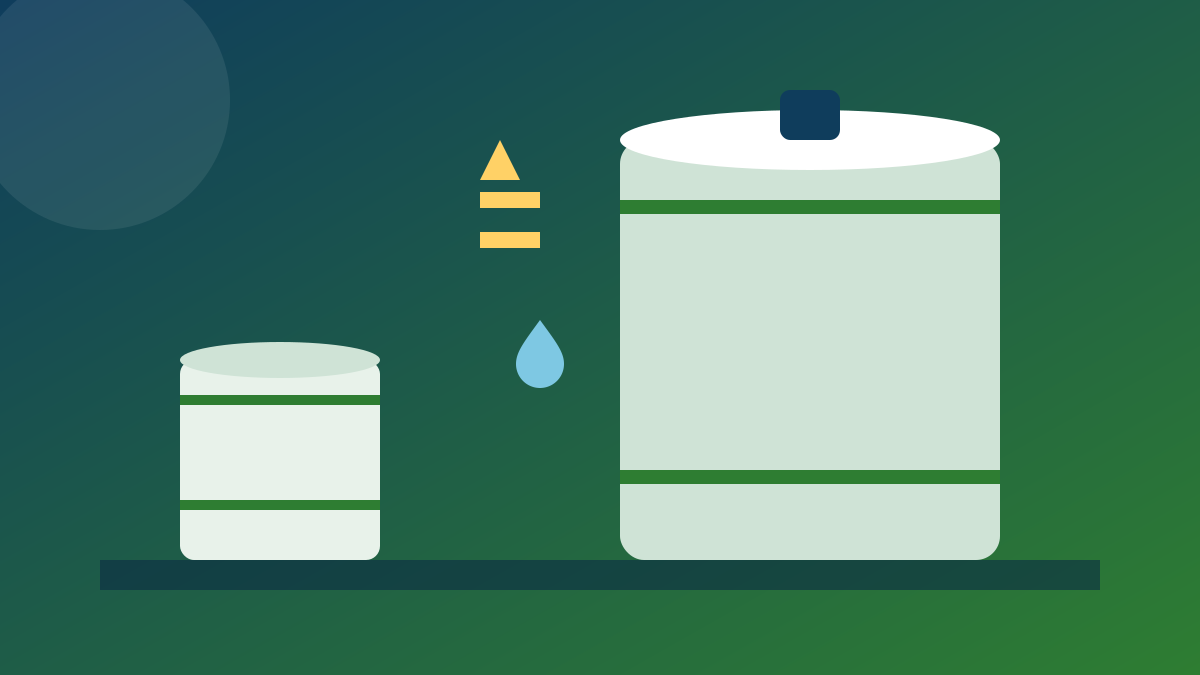
For most homes, a rain barrel is the right choice for watering ornamental beds, and a rain tank is the right choice only if you want to water a whole yard or a large lawn. A 55-gallon barrel costs 50 to 100 dollars, fits against a wall, and covers a bed or two. A 250-gallon tank costs several hundred dollars, needs a large level pad, and covers a whole yard. The roof produces the same water either way; the question is how much of it you can usefully store.
All stored rainwater is for non-potable use only: ornamental beds, lawns, and outdoor cleaning. It is not drinking water, and neither a barrel nor a tank changes that.
The Short Answer: Barrel for Beds, Tank for Whole-Yard Watering
Choose a barrel if you water ornamental beds near the house, if you have one or two downspouts to use, if your budget is under 100 dollars, or if you want to try rainwater harvesting before committing to a bigger system. Choose a tank if you water a large lawn, if you have a big roof and a dry climate, if you want to store water for weeks between rains, or if you already use two or three linked barrels and still run dry. Most people should start with a barrel, use it for a season, and only then decide whether a tank is worth it. A barrel teaches you how much water your roof actually produces and how much your garden actually uses, and that knowledge is worth more than a bigger container bought blind.
Size and Cost Comparison Table (55 Gal to 500+ Gal)
Prices are approximate US prices for new, purpose-built containers. Used food-grade drums are cheaper than the barrel prices below.
| Container | Capacity | Approx. cost | Weight when full | Footprint |
|---|---|---|---|---|
| Rain barrel | 55 gal | $50–$100 | ~460 lb | 2 ft × 2 ft |
| Two linked barrels | 110 gal | $100–$200 | ~920 lb | 4 ft × 2 ft |
| Three linked barrels | 165 gal | $150–$300 | ~1,380 lb | 6 ft × 2 ft |
| Small rain tank | 250 gal | $300–$600 | ~2,085 lb | 3 ft × 3 ft |
| Large rain tank | 500 gal | $500–$1,000 | ~4,170 lb | 4 ft × 4 ft |
The cost per gallon falls as the container gets bigger: a barrel costs about 1 to 2 dollars per gallon, while a 500-gallon tank costs about 1 to 2 dollars per gallon too, but the tank needs a pump, a stronger pad, and more plumbing, so the total system cost is higher. Weight is the hidden cost. A 500-gallon tank weighs over two tons when full, and it needs a concrete pad, not a wooden stand. A barrel needs a stand; a tank needs a foundation.
Worked Example: What a 1,000-Sq-Ft Roof Produces per Inch of Rain
A 1,000 square foot roof produces about 530 gallons from one inch of rain after 85 percent efficiency, and about 520 gallons after a 10-gallon first flush. That means one inch of rain fills nearly ten barrels, or about two 250-gallon tanks. A half-inch storm produces about 255 gallons, which fills about four and a half barrels or one 250-gallon tank. A 2-inch storm produces about 1,049 gallons, which fills about nineteen barrels or about four 250-gallon tanks.
The point is that no normal home storage captures a whole storm. A barrel captures the first 55 gallons. A 250-gallon tank captures the first 250 gallons. Both let the rest overflow, and both need a proper overflow route. The tank captures more of each storm, so it refills less often and lasts longer between rains, but it does not capture everything either. If your roof produces 530 gallons per inch and you store 250, you still overflow 280 gallons in a 1-inch storm. Storage is a buffer, not a dam.
Space, Weight, and Stand Requirements by Size
A barrel needs about 2 feet by 2 feet of wall, a stand 18 to 24 inches high, and firm level ground. Two barrels need about 4 feet of wall, three need about 6 feet. A tank needs a larger, flatter area: a 250-gallon tank needs about 3 feet by 3 feet, and a 500-gallon tank needs about 4 feet by 4 feet, on a concrete pad or compacted gravel that is perfectly level. A tank on a slope will tip, and a tank on soft soil will sink on one side and crack a fitting.
Weight decides the stand. A barrel stand must hold 460 pounds. A two-barrel stand must hold 920 pounds. A tank does not use a stand at all; it sits directly on the ground, and the ground must hold its full weight without settling. That is why tanks are usually placed on a concrete pad, and why they are hard to move once installed. Barrels can be moved by two people when empty. A tank, even empty, often needs three or four people, and a full tank cannot be moved at all.
When a Tank Makes Sense (and When It Is Overkill)
A tank makes sense when you water a large area every week, when your climate has long dry spells between rains, when you have already tried linked barrels and still run dry, or when you want to water a lawn rather than just beds. A 250-gallon tank gives you about four deep waterings of a 200 square foot bed, or about a quarter of an inch of water over 400 square feet of lawn. That is a real step up from a barrel, and for a keen gardener with a big yard it is worth the cost.
A tank is overkill when you water only containers and small beds, when your roof is small, when your budget is tight, or when you have not yet tried a barrel. A 500-gallon tank on a 500 square foot roof is a waste, because the roof does not produce enough water to fill it often. A tank in a wet climate is also overkill, because rain refills a barrel every few days anyway. Start small, measure your usage for a season, and buy a tank only when the numbers say a barrel is not enough.
A Practical Middle Path: Two or Three Linked Barrels
Two or three linked barrels are the practical middle path for most homes. Two barrels hold 110 gallons, cost 100 to 200 dollars, fit against a wall, and can be installed in an afternoon with basic tools. Three barrels hold 165 gallons, cost 150 to 300 dollars, and need 6 feet of wall. Linking is simple: place the barrels side by side, connect them near the top with a short hose, and put the overflow on the last barrel. If one barrel cracks, you replace one barrel, not a whole tank. If you move house, you take the barrels with you. For most gardens, linked barrels give you the storage you need without the cost, weight, and permanence of a tank.
FAQ
Is a rain barrel or a rain tank better?
A barrel is better for ornamental beds and for trying rainwater harvesting cheaply. A tank is better for watering a whole yard or a lawn, and for storing water through long dry spells.
How many barrels equal a 250-gallon tank?
About four and a half 55-gallon barrels. Two linked barrels hold 110 gallons; three hold 165 gallons. Beyond three barrels, a tank is usually better value.
How much does a 250-gallon rain tank weigh when full?
About 2,085 pounds, plus the tank itself. It needs a concrete pad or compacted gravel, perfectly level, and it cannot be moved when full.
Can I start with a barrel and upgrade to a tank later?
Yes, and that is the recommended path. Use a barrel for a season, learn how much water your roof produces and your garden uses, then buy a tank only if the numbers say you need one.

Leave a Reply