
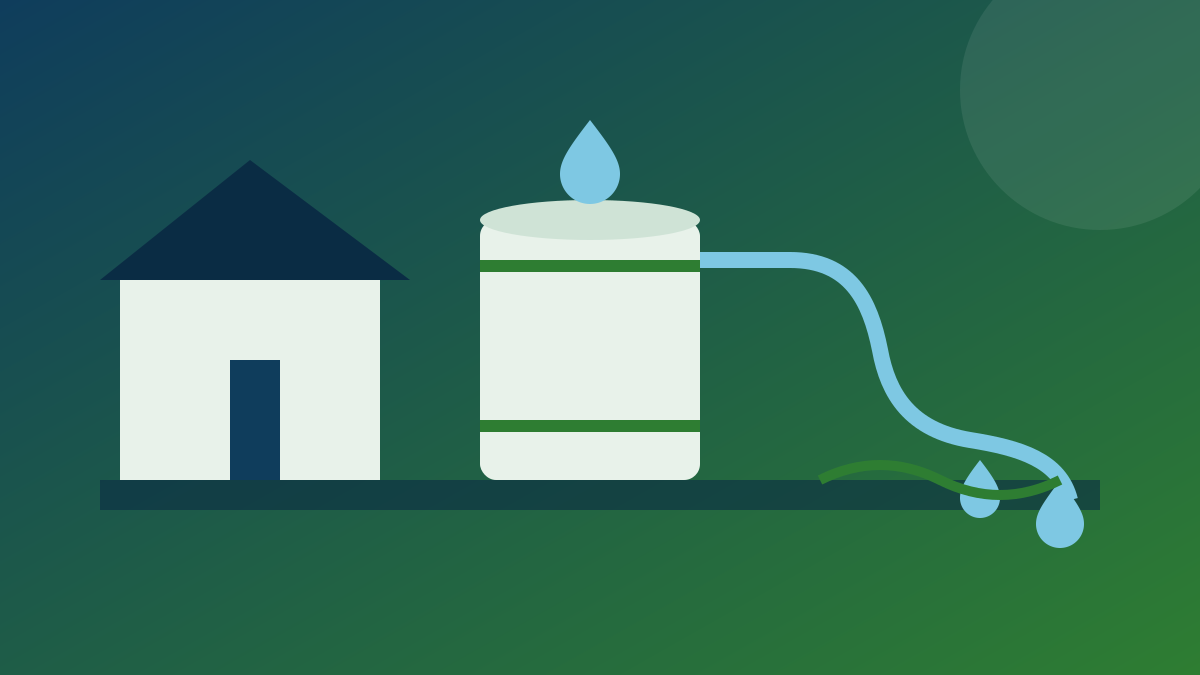
Rain barrel overflow should go at least 4 to 6 feet from your foundation, downhill, onto a lawn, an ornamental bed, a rain garden, or into a drain. That is the short answer, and it is the most important thing about a rain barrel system after the barrel itself. A barrel without a proper overflow is a flood waiting for the next storm, because a 1,000 square foot roof collects about 530 gallons from one inch of rain, and a single barrel holds only 55 of them.
Barrel water is for non-potable use only: ornamental beds, lawns, and outdoor cleaning. It is not drinking water, and overflow water is the same untreated roof runoff, so keep it off food crops and out of play areas.
What the Overflow Does and When It Runs
The overflow is a fitting near the top of the barrel, connected to a hose or pipe, that carries away water once the barrel is full. It runs in every storm big enough to fill the barrel, which in most of the US means most storms in spring and autumn. In a light shower the barrel may not fill at all, and the overflow stays dry. In a 1-inch storm on a 1,000 square foot roof, the barrel fills in the first few minutes and the overflow runs for the rest of the storm, carrying roughly 475 gallons past the barrel.
Think of the overflow as the second half of the system. The barrel stores the first 55 gallons for watering. The overflow handles the other 475 gallons safely. Without it, that water spills over the top of the barrel and runs down the side of the barrel, straight onto the soil next to the house. With it, the same water is carried away to a place that can absorb it. A barrel system is only as good as its overflow, because the overflow is what runs when the barrel cannot help any more.
Good Destinations: Beds, Lawn, Rain Garden, and Drains
The best overflow destination is a place that can absorb water slowly and is far enough from the house to be safe. A lawn is the simplest choice: grass and soil absorb a surprising amount of water, and a hose laid across the lawn spreads the flow. An ornamental flower bed is even better, because the plants use the water, and the soil there is usually loose and absorbent. A rain garden — a shallow planted dip designed to catch runoff — is the ideal destination if you have space, because it is built to hold water for a day and let it soak in.
A drain is the right choice when there is no absorbent ground nearby, for example on a paved yard or a steep slope. Connect the overflow hose to a storm drain, a dry well, or a French drain, and make sure the drain can take the flow without backing up. Whichever destination you choose, the water must flow downhill the whole way, with no low spot where it can pool. A hose that sags in the middle holds standing water, breeds mosquitoes, and blocks the flow, so support it or shorten it until it runs straight downhill.
How Far From the Foundation? The 3–4 Foot Rule
Water should reach the ground at least 4 to 6 feet from the foundation, and the common rule of thumb is a minimum of 3 to 4 feet for the overflow outlet itself, with the water then flowing further away. The reason is simple: soil next to a foundation is often backfilled and loose, so water there soaks straight down to the footing. Over time that water can seep into a basement or crawl space, crack a foundation, or wash soil away from under the footing. A hose that ends one foot from the wall is barely better than no hose at all.
Measure from the wall to the end of the hose, not from the barrel. If the barrel sits two feet from the wall, the hose needs to run at least another two to four feet beyond it. In clay soil, which absorbs water slowly, go further — six feet or more. On a slope, make sure the water flows away from the house, not across the slope and back toward it. If you cannot get the distance with a hose, use a rigid pipe or a splash block to carry the water further, or move the barrel to a downspout on a better side of the house.
Mistake 1: No Overflow at All
The most common and most damaging mistake is having no overflow at all. Many cheap barrels are sold with a spigot and a lid but no overflow fitting, and many first-time installers skip it because the barrel looks complete without one. The result is predictable: the first big storm fills the barrel, water spills over the rim, runs down the barrel and the wall, and pools against the foundation. In a basement house that can mean a wet basement after one storm. In a slab house it can mean soil erosion under the slab edge.
Fixing it is cheap and quick. Drill a hole near the top of the barrel, on the side facing away from the house, fit an overflow bulkhead or a short piece of pipe, and attach a hose that runs downhill to a safe spot. Do it before the next storm, not after the first flood. If you are buying a barrel, check that it has an overflow fitting or that you can add one easily. A barrel without an overflow is not a finished installation.
Mistake 2: Overflow Pointing at the House
The second mistake is an overflow that points the wrong way: a hose that ends against the wall, a pipe that discharges onto a path that slopes back toward the house, or an overflow on the house side of the barrel. The water leaves the barrel, but it ends up in the same place it would have gone without an overflow — against the foundation. Check the direction every season, because a hose can be knocked around by gardening, mowing, or a storm, and a hose that pointed away in spring can point at the wall by autumn.
The fix is to fit the overflow on the side of the barrel away from the house and to route the hose so it cannot swing back. A hose clip or a short length of rigid pipe holds the direction. If the barrel must sit close to the wall, run the hose along the wall and then turn it away at the end, so the outlet is well clear. Walk the route after a storm and look for puddles near the wall; if you find one, the overflow needs a longer hose or a different destination.
Mistake 3: Overflow That Floods a Path or a Neighbour’s Yard
The third mistake is an overflow that solves your problem by creating someone else’s: a hose that discharges onto a footpath, a driveway, or a neighbour’s garden. In winter that water freezes on a path and becomes a slip hazard. In summer it can flood a neighbour’s bed or wash soil onto their lawn, and in many places it is a legal nuisance. The overflow is your water, and you are responsible for where it goes.
Before you fix the outlet, look at where the water will go in the heaviest storm you expect, not just a light shower. A lawn that absorbs a light storm may flood in a 2-inch downpour. If the only downhill route is toward a path or a neighbour, use a rain garden or a dry well to absorb the flow, or connect to a drain. A soakaway — a buried pit filled with gravel — is a good option for a small yard. The rule is simple: the overflow must end on your own absorbent ground or in a proper drain, never on a path, a pavement, or someone else’s land.
FAQ
Where should rain barrel overflow go?
At least 4 to 6 feet from the foundation, downhill, onto a lawn, an ornamental bed, a rain garden, or into a drain. Never let it pool against the house.
How far from the house should the overflow outlet be?
A minimum of 3 to 4 feet, and 4 to 6 feet is better, especially in clay soil. Measure from the wall to the end of the hose.
Does every rain barrel need an overflow?
Yes. A 1,000 square foot roof produces about 530 gallons in a 1-inch storm, so every barrel fills fast. Without an overflow, the extra water spills against the foundation.
Can I connect the overflow to a drain?
Yes, if there is no absorbent ground nearby. Use a storm drain, a dry well, or a French drain, and make sure the drain can take the flow without backing up.

Leave a Reply