
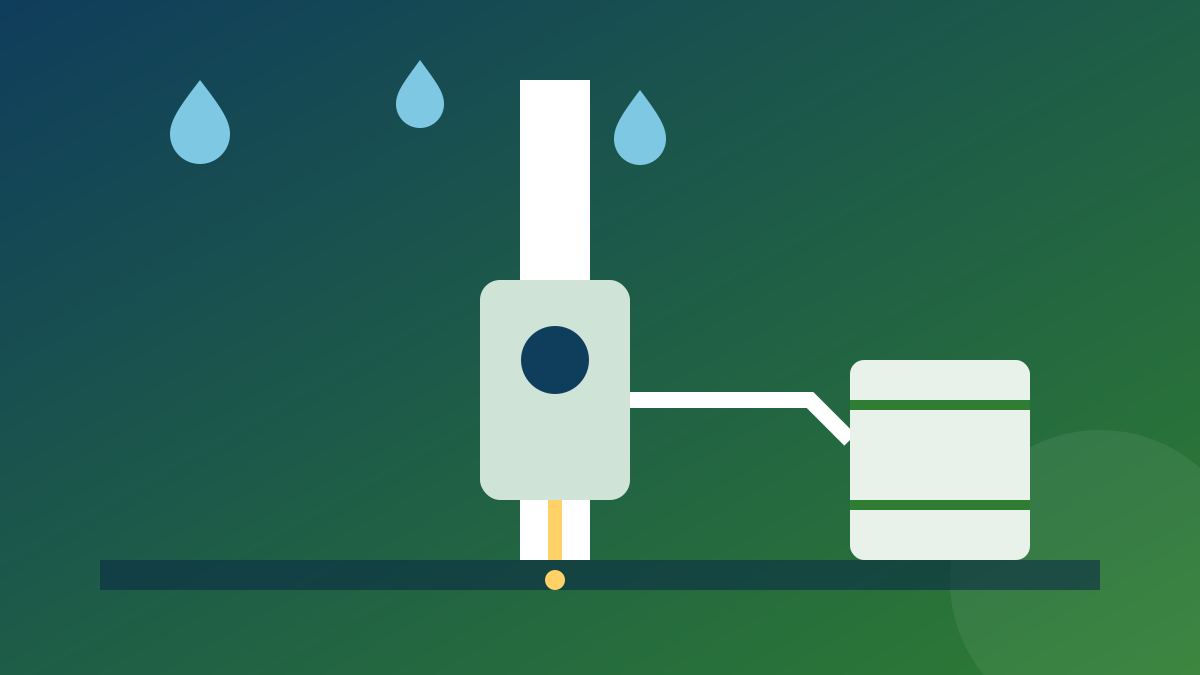
A first flush diverter should hold about 10 gallons for every 1,000 square feet of roof that drains into your barrel. That is the standard rule of thumb, and it is enough to send the dirtiest first water of a storm away from the barrel while keeping almost all of the storm for watering. For a 1,000 square foot roof, a 10-gallon diverter is the right size. For a 500 square foot roof section, 5 gallons is enough.
All water from a rain barrel is for non-potable use only: watering ornamental garden beds and lawns, and outdoor cleaning. A first flush diverter does not make rainwater safe to drink, and this article gives no drinking-water treatment advice.
What a First Flush Diverter Does (and What It Does Not Do)
The first rain after a dry spell washes everything off the roof: dust, pollen, leaves, bird droppings, and grit from shingles. That first slug of water is the dirtiest water your roof will ever produce. A first flush diverter catches it in a small chamber or pipe before it reaches the barrel, then lets the cleaner water that follows flow into the barrel instead. The result is a barrel with less sludge at the bottom, less smell, and less debris clogging the spigot.
What it does not do matters just as much. It does not filter the water, disinfect it, or make it safe to drink. The water that reaches the barrel is still untreated roof runoff, and it stays that way. The CDC says collected rainwater is not necessarily safe to drink without first removing germs and chemicals, and recommends tap or bottled water for drinking, cooking, and watering plants you plan to eat. A diverter improves barrel water for ornamental use; it does not change its category. Think of it as a dust filter for your garden water, not a purifier.
The 10-Gallon-per-1,000-Sq-Ft Rule, Worked Out
The rule is simple: first flush volume in gallons equals roof area in square feet divided by 100. A 1,000 square foot roof needs 10 gallons. A 1,500 square foot roof needs 15 gallons. A 2,000 square foot roof needs 20 gallons. If only one downspout feeds your barrel, use only the roof area that drains to that downspout, not the whole house. A house with a 2,000 square foot roof and four downspouts sends about 500 square feet of roof to each one, so each diverter needs only about 5 gallons.
How much water does that cost you? Very little. A 1-inch storm on a 1,000 square foot roof produces about 530 gallons after efficiency, so a 10-gallon first flush is under 2 percent of the storm. In a half-inch storm it is about 4 percent. You lose a small share of water and gain a much cleaner barrel, which is a good trade. The rule is a rule of thumb, not a law of physics: if your roof is under trees or near a busy road, a slightly larger diverter is sensible, and if your roof is clean metal, a slightly smaller one will do.
Sizing Table: Roof Size vs. First Flush Volume
| Roof area draining to the barrel (sq ft) | First flush volume | Typical diverter |
|---|---|---|
| 250 | 2.5 gal | Small pipe diverter |
| 500 | 5 gal | 5-gallon chamber |
| 1,000 | 10 gal | 10-gallon chamber |
| 1,500 | 15 gal | 15-gallon chamber |
| 2,000 | 20 gal | 20-gallon chamber |
Most off-the-shelf diverter kits come in 5-gallon or 10-gallon sizes, and many are built as a length of 4-inch PVC pipe with a ball that seals when it fills. If your roof needs 15 gallons and the kit only holds 10, you can use two 10-gallon diverters in series, or accept a slightly smaller first flush. Do not oversize wildly: a 20-gallon diverter on a 500 square foot roof throws away a big share of every small storm, and in dry climates that waste adds up.
Where the Diverter Fits in Your Downspout Line
A first flush diverter fits in the downspout line between the gutter and the barrel, usually at or just below the height of the barrel inlet. Water from the downspout enters the diverter chamber first. While the chamber fills, a ball or float rises and seals it off, and the water that follows is sent sideways into the barrel. Some designs use a slow-drip drain at the bottom of the chamber, so it empties itself between storms and is ready for the next one. Others need a manual drain: you open a small valve after each storm to empty the dirty water.
Place the diverter where you can reach it easily, because you will need to clean it. It sits below the gutter and above the barrel inlet, in a straight run of downspout, with the barrel inlet hose connected to its side outlet. Keep the chamber vertical so the float seals properly, and make sure the drain at the bottom is not blocked by mulch or soil. If the diverter is part of a downspout diverter kit, follow the kit instructions: some kits combine the first-flush chamber and the barrel diverter in one unit.
Cleaning and Maintaining the Diverter
A diverter full of sludge does the opposite of its job, so clean it at least twice a year and after any big leaf fall. Open the bottom valve or cap and let the dirty water out onto a lawn or bed, away from the foundation. Flush the chamber with a garden hose, and check the ball or float moves freely. If it sticks, clean the seat it rests on. Check the mesh screen at the inlet for leaves, and replace a torn screen at once — a torn screen lets debris straight into the barrel.
In autumn, check the diverter monthly if your roof is under trees, because leaves can block it in a single storm. In winter, drain it completely before the first hard freeze, or the water inside will freeze, expand, and crack the chamber. A diverter that is cleaned and drained on schedule lasts for years. One that is ignored becomes a clogged pipe that sends dirty water into the barrel anyway.
Do You Even Need One? When to Skip It
You can skip a first flush diverter in three situations. First, if your roof is clean metal with no overhanging trees, the first water is not very dirty, and a good mesh screen may be enough. Second, if you only use barrel water for washing tools and walkways, where a little grit does not matter. Third, if you clean the barrel often and do not mind sludge at the bottom. In every other case, fit one: it costs little, it keeps the barrel cleaner, and it cuts the smell that comes from rotting debris. A barrel without a diverter still works, but you will scrub it more often and the water will smell worse in summer. For most homes, the 10-gallon rule and a simple chamber are the cheapest upgrade a rain barrel system can get.
FAQ
What size first flush diverter do I need?
About 10 gallons per 1,000 square feet of roof draining to the barrel. A 500 square foot roof section needs 5 gallons; a 2,000 square foot roof needs 20 gallons.
Does a first flush diverter make rainwater safe to drink?
No. It only removes the dirtiest first water of a storm. Barrel water stays untreated roof runoff and is not safe to drink. Use it for ornamental beds, lawns, and outdoor cleaning only.
How often should I clean a first flush diverter?
At least twice a year, and monthly in autumn if trees overhang the roof. Drain it after each storm if it has a manual valve, and always drain it before winter.
Can I use a first flush diverter with any barrel?
Yes, as long as it fits in the downspout line above the barrel inlet. Most kits work with any 55-gallon barrel and any standard downspout size.

Leave a Reply