
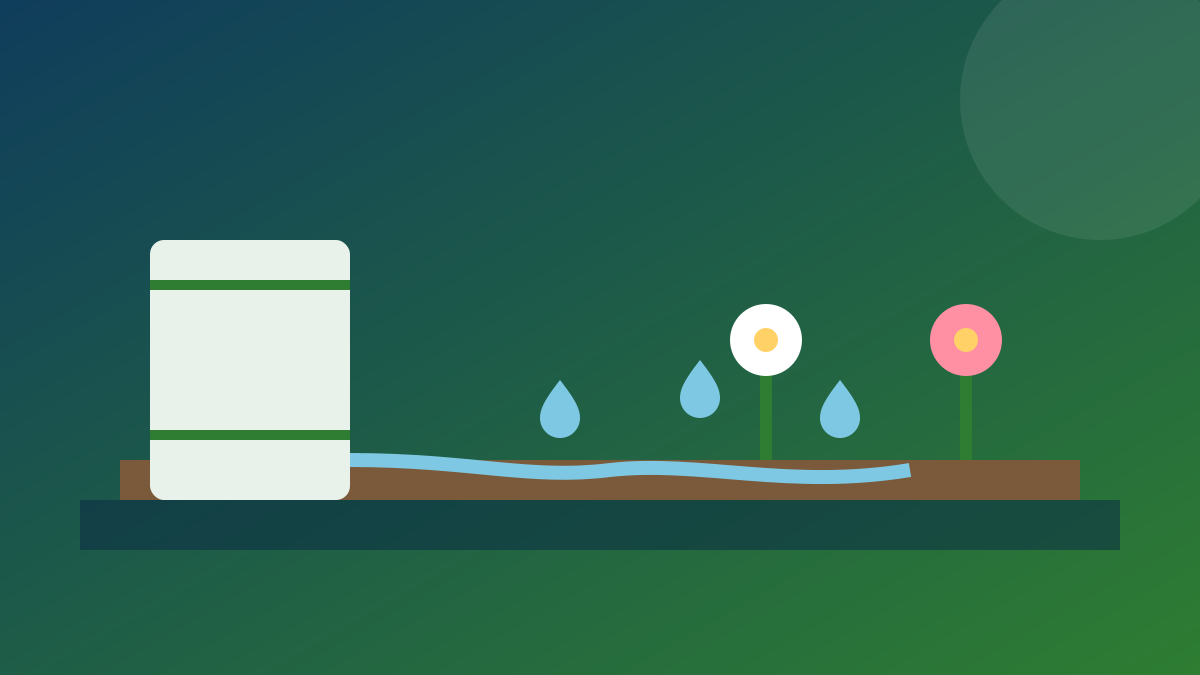
Water the garden with a rain barrel by raising the barrel 18 to 24 inches on a stand, running a soaker hose from the spigot to the bed, and letting gravity do the work. The water flows slowly at soil level, straight to the roots, with no pump, no electricity, and no sprinkler. A watering can filled at the spigot does the same job for containers and small beds, and it is the most precise method of all.
Barrel water is for non-potable use only: ornamental beds, lawns, and outdoor cleaning. The CDC recommends tap or bottled water for plants you plan to eat, so keep barrel water on ornamental plantings and lawns.
The Short Answer: Raise the Barrel, Run a Soaker Hose, Water the Soil
The whole method is three steps. Raise the barrel so the water has height behind it. Connect a hose to the spigot. Water the soil, not the leaves. Height gives you pressure, the hose carries the water, and soil-level watering puts it where the roots are. A barrel on the ground has no pressure at all, because the spigot is at the same level as the bed. A barrel on a stand 18 to 24 inches high has enough pressure for a short soaker hose, and that is all most beds need. If you want to water a bed 20 feet away, you will need a longer hose and a higher stand, or you will need to carry a watering can. Gravity is free, but it is weak, so work with it, not against it.
Gravity Pressure Explained: 18–24 Inches Gives About 0.8–1 PSI
Water pressure from gravity is simple: every foot of height gives about 0.43 pounds per square inch, or psi. A barrel on a stand 18 inches high gives about 0.65 psi at the spigot. A stand 24 inches high gives about 0.86 psi. A stand 36 inches high gives about 1.3 psi. That is very low compared with tap water, which is usually 40 to 60 psi, but it is enough for a soaker hose, because a soaker hose is designed to weep water slowly along its length, not to spray it.
The pressure also drops as the barrel empties, because the water level falls. A full barrel on a 24-inch stand gives about 0.86 psi plus the height of the water in the barrel, which is about 3 feet, so the total is about 2 psi when full and about 0.86 psi when nearly empty. That is why flow slows as the barrel empties, and why a soaker hose works best when the barrel is at least half full. Do not expect a sprinkler to work on gravity pressure; a sprinkler needs tap pressure, and a barrel cannot give it.
Soaker Hose vs. Drip Line vs. Watering Can
A soaker hose is a porous hose that weeps water along its whole length. Lay it on the soil in a bed, turn on the spigot, and it waters the bed evenly and slowly. It is the best choice for a long bed, it uses water efficiently, and it costs about 10 to 20 dollars. Its weakness is that it clogs with algae and sediment, so use a filter or a screen at the spigot, and flush it occasionally.
A drip line is a hose with emitters spaced along it, each one dripping water at a set rate, usually half a gallon or one gallon per hour. It is more precise than a soaker hose, because you can place an emitter at each plant, and it uses even less water. Its weakness is the same: emitters clog, and they need clean water and a filter. A drip line is the best choice for a bed with widely spaced plants, such as shrubs or roses.
A watering can is the simplest and most precise method. Fill it at the spigot, carry it to the bed, and water each plant at the base. It uses the least water, it never clogs, and it works for containers, small beds, and plants that need individual attention. Its weakness is time: carrying a can back and forth is slow for a large bed. For most homes, the best combination is a soaker hose for the main bed and a watering can for containers.
Worked Example: How Far a 55-Gallon Barrel Reaches
A 55-gallon barrel reaches further than most people expect, if you water at soil level. A 100 square foot ornamental bed needs about 31 gallons for a deep half-inch watering, so one barrel gives you almost two deep waterings of that bed. A 200 square foot bed needs about 62 gallons for a deep watering, so one barrel gives you most of one deep watering, or two light waterings of about 31 gallons each. A soaker hose 25 feet long laid in a 100 square foot bed will use about 31 gallons in 30 to 60 minutes, depending on the pressure and the hose.
For a lawn, the numbers are bigger. One inch of water over 1,000 square feet of lawn is about 620 gallons, so one barrel waters about 90 square feet of lawn to a depth of one inch. That means a barrel is not a lawn-watering tool; it is a bed-watering tool. Use the barrel for the beds near the house, where the soaker hose reaches, and use tap water for the lawn. A barrel that waters a bed well is doing its job, even if it cannot water a lawn.
Layout: Hose Length, Beds, and Slope
Layout matters because gravity is weak. Keep the hose short — 25 feet or less is ideal, and 50 feet is the practical maximum for a soaker hose on gravity pressure. Longer hoses lose pressure along their length, and the far end will barely weep. Lay the hose downhill or level, never uphill, because water will not flow uphill on gravity pressure. If the bed is uphill from the barrel, move the barrel or use a watering can.
Place the barrel as close as possible to the bed you water most, usually the downspout nearest the front or back bed. Run the soaker hose in a gentle curve, not a sharp kink, because a kink blocks the flow. If you have two beds, use a Y-splitter at the spigot and run a hose to each, but open only one at a time, so the full pressure goes to one hose. Check the hose after the first use: if the far end is dry, the hose is too long or the barrel is too low.
Common Problems: Weak Flow, Clogged Emitters, Kinked Hose
Weak flow is the most common problem, and it usually means the barrel is low, the stand is too short, or the hose is too long. Raise the stand, shorten the hose, or wait for rain to refill the barrel. Clogged emitters mean algae or sediment in the water; clean the barrel, clean the first-flush diverter, and fit a small filter or screen at the spigot. A kinked hose means the hose is bent too sharply; straighten it, or replace it with a hose that holds its shape.
If the soaker hose weeps at one end and not the other, the hose is too long or the pressure is too low. If the watering can fills slowly, the spigot screen is clogged; clean it. If the barrel empties faster than you expect, check for a leak at the spigot or the overflow. Most watering problems are layout problems, not barrel problems, and a short hose, a level stand, and clean water fix most of them.
FAQ
Can I use a soaker hose with a rain barrel?
Yes. A soaker hose is the best method for a bed, because it waters at soil level and uses water efficiently. Keep the hose under 25 feet and the barrel on a stand 18 to 24 inches high.
How much pressure does a rain barrel give?
About 0.8 to 1 psi from a stand 18 to 24 inches high, plus the height of the water in the barrel. That is enough for a soaker hose or drip line, but not for a sprinkler.
How far will 55 gallons go in the garden?
About two deep waterings of a 100 square foot ornamental bed, or one deep watering of a 200 square foot bed. It waters about 90 square feet of lawn to a depth of one inch.
Should I water leaves or soil with barrel water?
Soil. Use a soaker hose, drip line, or watering can at the base of the plant. Overhead watering wastes water and wets leaves.

Leave a Reply